Suppose that you want to know how fast a team of mobile agents can solve some problem, and whether the question is still open. The answer is rarely in one paper. One paper assumes synchronous rounds, another assumes that the agents start at one node, and a third allows some of them to crash. Thus the results on one problem are scattered over many sets of assumptions, and it is hard to tell which of them are comparable, which bound is the best one, and what remains open.
Mobility Matters is a public atlas that puts these results in order. It covers distributed computing by mobile entities: agents moving on graphs, robots in the plane, robots searching geometric domains, and programmable matter. Version 2026-11-18 contains 60 problems, 426 settings and 772 papers.
A setting is a set of assumptions
Each of the four models declares its assumption axes, for example timing, faults, communication and identifiers. Every axis is a scale. Level 0 assumes nothing on that axis, which is the most hostile environment the axis allows: asynchronous agents, silent agents, strong Byzantine faults. Each higher level is a stronger assumption, which makes a problem easier. Values on the same level, such as ring, tree and grid, are alternatives that do not imply each other.
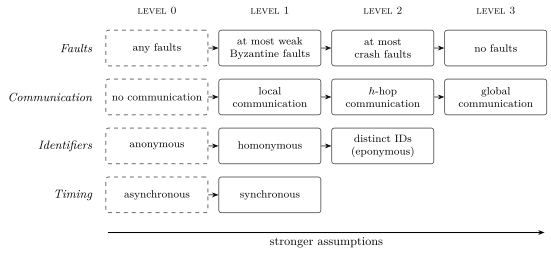
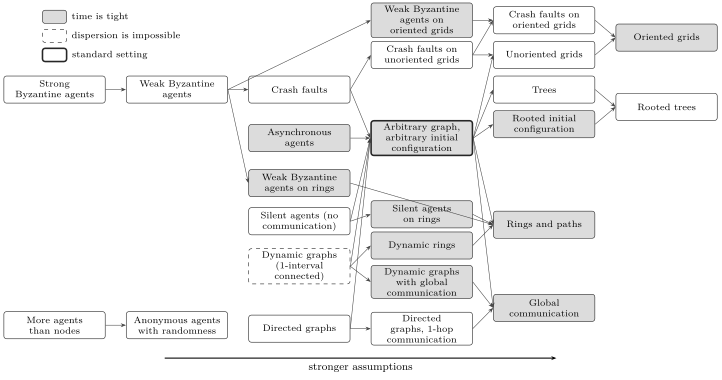
A setting of a problem is a set of assumptions: one value on every axis. The setting that assumes nothing comes first, and each edge leads to a setting that assumes more. Assumptions on different axes are independent, so a setting can have several parents, and the settings of a problem form a directed acyclic graph. The atlas then derives what carries over.
An algorithm designed for weaker assumptions works under stronger ones, and a lower bound proved under stronger assumptions holds under weaker ones.
An example: dispersion
In the dispersion problem, agents are placed on the nodes of a connected graph with nodes and edges, and they must reach a configuration in which every node hosts at most one agent. The atlas marks one setting of each problem as the standard setting, in which the problem is normally studied. For dispersion, the agents of the standard setting have unique identifiers, the graph is arbitrary and anonymous, the rounds are synchronous, communication is local (agents at the same node communicate), there are no faults, and the agents know nothing about the graph.
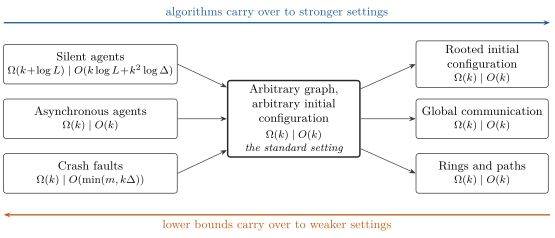
The table shows what the atlas records for the time, in rounds, in four of these settings.
| Setting | Lower bound | What forces it | Best result | Status |
|---|---|---|---|---|
| Silent agents (no communication) | timing is the only channel | gap | ||
| Crash faults | distance | gap | ||
| Arbitrary graph, arbitrary initial configuration (standard) | distance | tight | ||
| Global communication | distance | tight |
In the standard setting, the lower bound is forced by distance: the instance is a path with all agents on one endpoint. The atlas records that Augustine and Moses Jr. introduced the problem with time for agents that know and , and that the current best result, by Kshemkalyani, Kumar, Molla, Pattanayak and Sharma, takes rounds with bits of memory per agent. Hence the time is tight. The memory is not: the lower bound is , and one open question of this setting is whether bits, independent of , are enough while keeping time.
The example also shows both directions of the order. The best result recorded with global communication is the algorithm of the standard setting, and the atlas calls its bound inherited. In the other direction, the lower bound recorded for crash faults is the fault-free bound, and the atlas notes that no crash-specific lower bound is known. The open question of that setting is: is time achievable with crash faults, or does fault tolerance cost a factor of ? For silent agents, the lower bound was proven on rings and hence holds for arbitrary graphs. There the question is whether is achievable, as it is on rings.
What a setting records
Every lower bound names its bottleneck, a two- or three-word name for what forces the bound, such as "distance", "symmetry breaking" or "timing is the only channel". The gap is a status for each complexity measure: tight if the upper and lower bounds match asymptotically, near if the gap is at most polylogarithmic, gap if it is polynomial, unknown if there is no non-trivial lower bound or no algorithm, and impossible if the setting is provably unsolvable.
Four models
The atlas is organised as model, problem family, problem and settings. The 60 problems belong to six families.
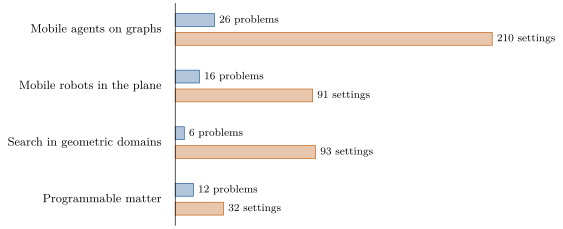
- Mobile agents on graphs. Memory-bounded agents move along the edges of a port-labelled graph. Examples are exploration, dispersion, rendezvous and black hole search.
- Mobile robots in the plane. Anonymous point robots repeat Look–Compute–Move cycles. Examples are gathering and pattern formation.
- Search in geometric domains. Robots with unit speed search a line, rays, a disk or a polygon for a target or an exit. Examples are linear search and evacuation.
- Programmable matter. Particles with constant memory on the triangular lattice must form a shape or elect a leader.
Every problem opens with a first look for newcomers: a plain-language explanation, a simple algorithm with its analysis, and the main impossibility. Eleven essays, called perspectives, connect the problems across models.
How it is kept correct and current
A setting is marked verified only after its bounds are checked against the full text of the paper, that is, its model, its assumptions and its theorems, and not only the abstract. The other settings are marked draft. In version 2026-11-18, 390 of the 426 settings are verified. The atlas states that Claude (Anthropic) was used in cataloguing the problems and that the maintainer reviews the content.
A search for new papers runs every week. Versions are dated, and the changelog says what changed in each one. For example, version 2026-11-18 records two preprints with -competitive algorithms for online exploration of weighted graphs, which improve on the of the nearest-neighbour rule from 1977. The lower bound is still 4, and whether a constant ratio is possible stays open.
The website and the book, which is the PDF linked below, are built from the same data.
How to use it and how to contribute
A reader can start from a problem and follow its settings, or pick a model and some assumptions on the Explore page to see what is known there. For each problem, the atlas then shows the algorithms of the closest weaker settings and the lower bounds of the closest stronger ones.
Readers who find a mistake, a missing result or a missing problem can open an issue in the source repository. A submission is accepted only after the result is checked against the full text of the paper, and everyone whose issue leads to a change is listed in the acknowledgements of the website and the book. The text and the data are under the licence CC BY 4.0. The atlas asks to be cited as a whole, and for a result it asks readers to cite the paper that it gives for that result.