Research Notes in Look-Compute-Move
Distributed algorithms for robots and agents that move, on graphs and in the plane. Each entry has an explainer, the paper, and where it helps, a simulator that runs in the browser.
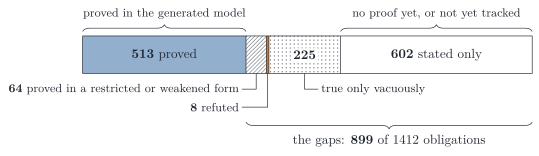
Mobility Matters is a living survey of open problems on autonomous agents, robots and particles. This project states the models, the assumptions and the published results of the survey in Lean 4, proves what it can, and refutes or qualifies what does not hold as stated. The purpose is to find the gaps of the area and to fill them, and several questions that the survey lists as open are now answered.
of 1412 generated obligations proved in Lean in the generated model of their variant.
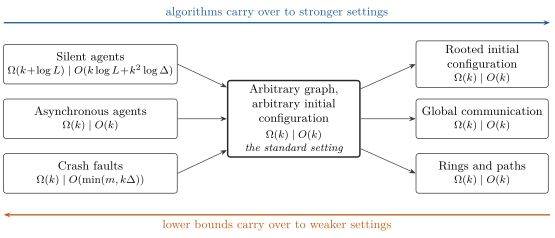
Mobility Matters is a public atlas of research problems in distributed computing by mobile entities: agents moving on graphs, robots in the plane, robots searching geometric domains, and programmable matter. The settings of each problem form a directed acyclic graph, in which algorithms carry over to stronger settings and lower bounds to weaker ones. For every setting the atlas records the proven lower bounds and what forces them, the paper that introduced the setting, the current best result, the gap between them, and the open questions.
problems, with 426 settings and 772 papers, in version 2026-11-18.
I study what swarms of simple mobile robots and agents can compute together: how they gather, explore, disperse and form patterns, and how much failure they can tolerate.